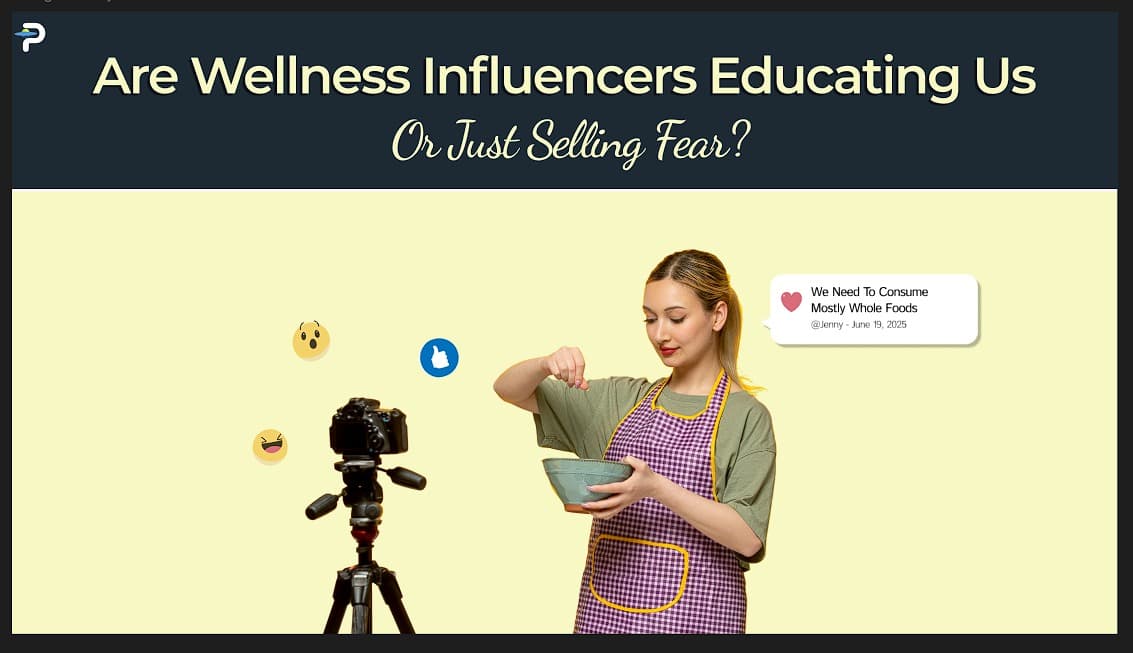
The uncomfortable question is this: are these influencers spreading real knowledge, or are they bluffing with confidence and aesthetics?
The honest answer is not black and white. Some share useful insights. Many others oversimplify complex science, amplify fear, and blur the line between health education and marketing.
Modern wellness content thrives on alarm. Declaring something “bad” grabs attention far faster than explaining nuance. Nutrition science, however, is slow, conditional, and context-dependent. Social media rewards the opposite.
When an influencer labels a food toxic, it often ignores dose, frequency, individual metabolism, and overall diet quality. A substance can be harmful in one context and harmless or even beneficial in another. That complexity rarely fits into a 30-second reel.
This is how normal foods become villains. Oils used for centuries are suddenly framed as inflammatory poisons. Staple grains are blamed for unrelated lifestyle diseases. Even home-cooked meals are portrayed as inferior to “clean” influencer-approved diets.
Fear becomes the hook. And fear sells.
A common pattern in wellness content is the personal transformation story. “I removed this food and felt amazing.” These stories feel convincing because they are emotional and relatable. But they are not evidence.
What often goes unsaid is that lifestyle changes usually happen together. Better sleep, more movement, reduced processed food, stress reduction, and calorie awareness often occur at the same time. Highlighting one ingredient and calling it the miracle fix is misleading.
Science relies on controlled studies, not isolated experiences. Influencers rarely distinguish between correlation and causation. This creates the illusion of certainty where none exists.
Another worrying trend is the moralisation of food. Foods are labelled “clean” or “dirty,” “good” or “bad.” This framing turns eating into a character test instead of a biological process.
In reality, health is shaped by long-term patterns, not single ingredients. A balanced diet that includes occasional processed foods is not unhealthy by default. Stressing over food purity can be more damaging than the food itself.