The information provided on this publication is for general informational purposes only. While we strive to keep the information up to date, we make no representations or warranties of any kind about the completeness, accuracy, reliability, or suitability for your business, of the information provided or the views expressed herein. For specific advice applicable to your business, please contact a professional.


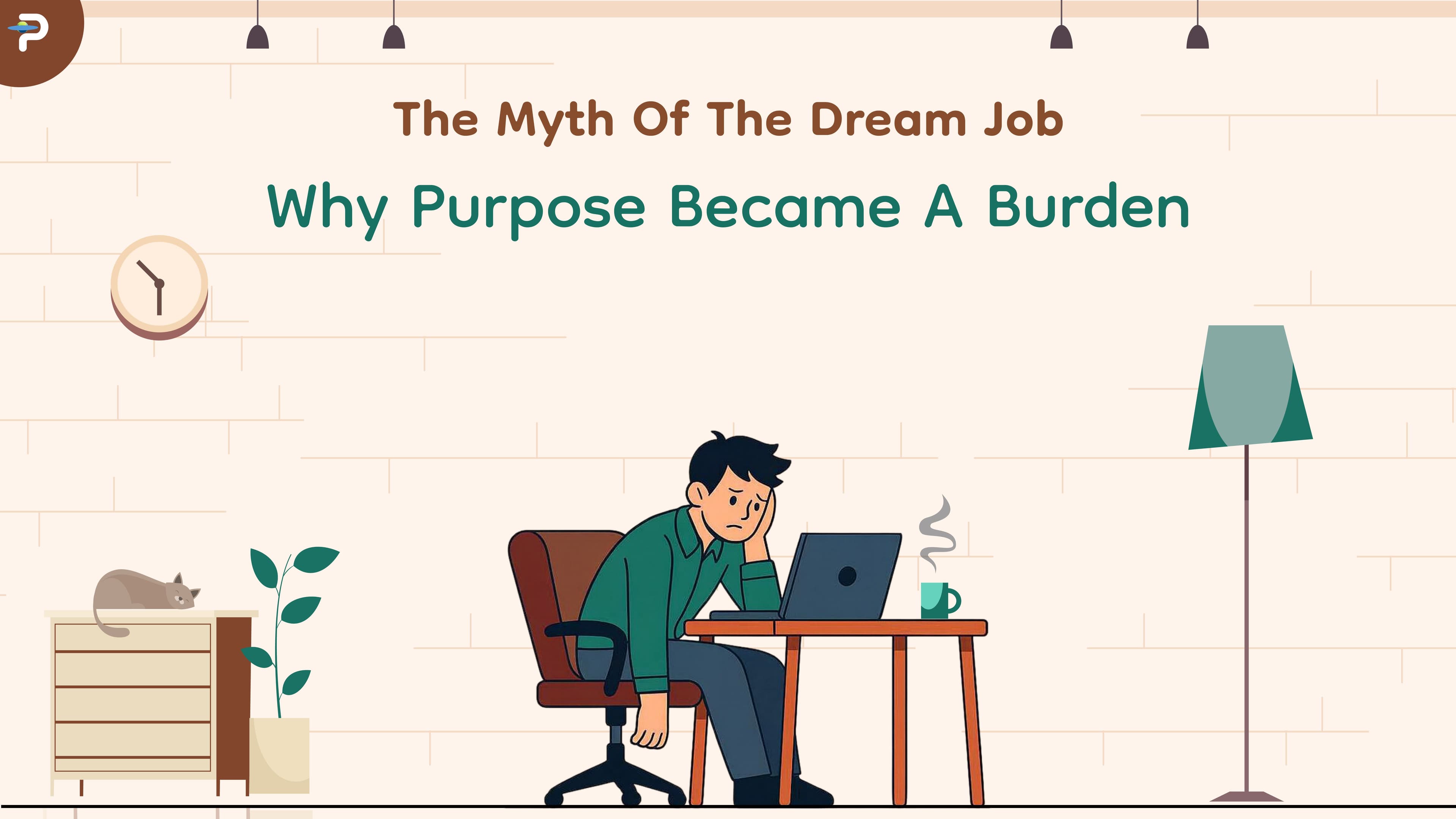
It sounded beautiful. Almost magical. But as we entered adulthood, many of us discovered a quieter, heavier truth: the pursuit of a dream job can feel less like freedom and more like pressure.
Somewhere along the way, purpose stopped being something personal and became something we felt judged for.
You’re supposed to love your job. You’re supposed to feel “fulfilled.” You’re supposed to wake up excited.
And when you don’t? You begin to wonder if something is wrong with you.
This is the burden no one warned us about.
Our grandparents didn’t expect their jobs to complete them. Work was stability, not identity. They found purpose in family, routines, rituals, friendships, community moments, festivals, and slow Sundays.
Today, many of those anchors have weakened. We relocate for opportunities. We drift away from childhood friends. We have fewer traditions to fall back on. And often, life feels like it’s built on moving pieces.
So naturally, the weight of purpose shifted to work. If everything else feels temporary, the career becomes the one stable thing we’re told to build meaning around.
Companies saw this shift and leaned into it. Suddenly job ads promised “impact.” Teams were “families.” Offices were “communities.” Every job wanted your soul, not just your skills.
And if you didn’t feel emotionally connected to this system, you felt like an outsider.
A lot of people wake up every morning with an odd, quiet guilt: Why don’t I feel passionate? Why doesn’t this feel meaningful? Why am I not inspired like everyone else seems to be?
It’s not that the work is bad. It’s just that the expectation was unrealistic.
The truth is, there’s absolutely nothing wrong with you if your job feels like… well, a job. Most work is ordinary. Most careers are built slowly. Most days are routine.
But when society brands meaning as the ultimate metric of success, normalcy starts to feel like failure.
And that’s not fair.

Life isn’t a straight line. Your 22-year-old dream isn’t supposed to be your 32-year-old dream. It’s normal to outgrow goals, industries, bosses, or even your idea of success. But the myth of the dream job convinces us that choosing “wrong” means we’ve failed permanently.
So people panic. They switch jobs constantly. Or they stay frozen because they fear choosing incorrectly. Others burn out trying to pour purpose into a role that was never designed to hold that much emotional weight.
Purpose was meant to be light. But we made it heavy.
Loving your work is wonderful, but it’s also risky. If your identity wraps too tightly around your career, rejection feels personal. A bad performance review can feel like a character flaw. A slow year feels like your life is collapsing. One toxic manager can shake your confidence for months.
When work becomes the centre of meaning, everything else becomes fragile.
What if purpose doesn’t have to be this huge, dramatic thing? What if meaning is allowed to be small, gentle, quiet?
Maybe purpose is:
Maybe the dream job isn’t a specific role at all. Maybe it’s any job that gives you enough emotional space to build a meaningful life outside it.
We forget this: You are allowed to work for money. You are allowed to like your job without loving it. You are allowed to find purpose in moments that have nothing to do with work.
Purpose comes from the relationships you build, the things you learn, the small joys you allow yourself to feel, the person you grow into. Work can support those things, but it should not define them.
The myth of the dream job promised endless fulfilment. But the truth is simpler: Most of us just want a life that feels peaceful, steady, and ours.
Purpose is not something you chase. It’s something you create, slowly, imperfectly, and often outside office hours.
Once we understand that, the burden lifts. Work becomes one part of life, not the centre of it. And purpose becomes something we live, not something we hunt.
Discover more articles you may like.
Some top of the line writers.
Best Articles from Top Authors